
Depending on the fleet size and its age, airlines buy 30-50 per cent of the components that they need, and take the rest on lease. Expenditure on spares and components is a considerable part of engineering and maintenance, which account for over 9-10 per cent of the total operating expense of an airline. For instance, Air India, which has a large and ageing fleet, has to provide $35 million-$40 million for spare parts during any time of the year.
The 31 rigs were operating in India's offshore areas till February this year, making the country the largest offshore rig user in the world after the US, where 56 rigs are operating. Countries such as Brazil and Mexico have now overtaken India.
India's pioneer of low-cost carriers GR Gopinath is in talks with Cochin International Airport Limited, India's first privately operated airport, to set up a joint venture for dedicated cargo facilities across the country.
National carrier Air India's strategy to cut full-service flights and replace them with low-cost services by Air India Express on its West Asian routes has backfired. The passenger load factor of the flag carrier's low-cost subsidiary for West Asia has fallen a steep 11 percentage points over the last six months as a result of competition from new low-cost entrants and fare wars by incumbents. The PLF on the Dubai-India route fell from 83 to 78 per cent in the same period.
The government is coming out with a policy for setting up greenfield airports for general aviation in the next three to four months. It is also planning to introduce an air cargo policy soon.The broad contours of the policy for general aviation, which includes private charters and corporate jet operations, are more or less in line with the merchant airport policy.
The Delhi government has requested airlines to come up with a detailed note on how decrease in sales tax on aviation turbine fuel (ATF) will lead to higher offtake of fuel from Delhi airport, before taking any measure for reduction in taxes. Airlines have been repeatedly making representations to the state government asking for a reduction in sales tax on ATF from the current 20 per cent to 4 per cent.
From zero presence in the Indian power equipment market a couple of years ago, Chinese companies are likely to supply as much as 30 per cent of the equipment required to meet the Eleventh Plan capacity addition target of 78,000 Mw.Chinese companies are also bagging large orders from private power companies in India, despite the perception of "suspect quality".
The three state-owned oil marketing companies say they expect to report losses in the fourth quarter of the 2007-08 financial year with the government likely to bear 42.7 per cent of their retail losses against the 57 per cent it had promised in February. The three companies, IOC, BPCL and HPCL bear revenue losses because they are forced to sell petrol, diesel, cooking gas and kerosene at subsidised prices.
Sometime in the second half of this year, Vijay Mallya-controlled Kingfisher Airlines will start operating chartered flights with two helicopters in and around Mumbai. Later, it will also press into service a handful of very light jets.
The mandatory 10 per cent ethanol blending in petrol may not happen for the existing 101 million vehicles on the Indian roads without introducing technical changes in them. The central government plans to make 10 per cent blending compulsory from October from the current 5 per cent. Existing vehicles are not capable of running on 10 per cent ethanol-blended petrol as ethanol releases more heat and can corrode vehicle engines, experts say. It will lead to a 3% drop in mileage.
The govt is likely to propose to the EU that it will validate security procedures in its airports before allowing passengers to carry duty-free goods to India. This is in retaliation to a similar proposal made by EU last year, which led to protests from companies operating duty-free shops in India. EU officials would have to validate the security systems at Indian airports before allowing transit passengers to buy at duty-free shops here, resulting in dispute between the two.
The retail losses that the country's oil marketing companies incur on sale of petrol, diesel, cooking gas and kerosene at subsidised prices have risen by 7.3 per cent to around Rs 440 crore (Rs 4.4 billion) per day in the fortnight ended March 31.IOC lost Rs 17 for every litre of petrol it sold, up from Rs 14.65 a litre on March 15. It lost Rs 316 per 14.2-kg cylinder, compared with Rs 303.65 per cylinder in the previous fortnight.
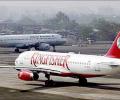
With major predictions of a deceleration in domestic air traffic, airlines are lowering seat capacity by reducing the number of flights or dropping fares in order to fill up their seats. They have also begun the process of reducing the number of aircraft that they were planning to to induct in their fleet as part of their expansion plans. Management consultancy firm Ernst & Young recently estimated that domestic traffic would grow by 24.16 per cent this year
The over 1.6 million employees of central public sector companies are demanding a salary increase of over 100 per cent, saying the average 40 per cent raise recommended by the Sixth Pay Commission for government employees is not enough. Salaries of public sector workers were last revised in 1997 and were scheduled for the next revision on January 1, 2007. The average gross monthly salary an ONGC executive earns today is between Rs 40,000 and Rs 50,000.
In a step towards dual pricing of domestic cooking gas, the government has decided to allow oil-marketing companies to sell the fuel at market prices in distinct fibreglass cylinders. IOC, BPCL and HPCL will sell these cylinders in Bangalore, Mumbai and Pune, which have been identified as test beds for the pilot project. The companies could revise fuel prices for transparent cylinders as LPG for them will not be subsidised. Feasibility of this project is yet to be adjudged.
The Mumbai airport has decided not to allow additional flights this summer, thanks to infrastructure bottlenecks. This is likely to spoil the expansion plans of all carriers, including private players like Kingfisher, Simplifly Deccan and Jet Airways. However, airlines have been allowed to re-apply for additional flights as & when they get delivery of new aircraft during the summer. Kingfisher had to shelve 11 additional flights out of Mumbai while Deccan has rescheduled too.
Labayendu Mansingh, Chairman of the Petroleum and Natural Gas Regulatory Board, is an amicable yet tough man. In his 5 months as the petroleum & natural gas regulator, Mansingh announced to the oil & gas industry his intention of proving that the regulatory board is more than a toothless tiger. The board will come out with its first set of regulations, which will lay down rules for the distribution of gas to households, vehicles & industries in cities by middle of this month.
Aviation experts say the existing airports cannot be viable.
"We are definitely planning a multi-modal connectivity to certain places apart from destinations we operate. Though we are primarily looking at railways, we might also look at other means of transport such as roads," said Edgardo Badiali, CEO, GoAir to Business Standard. When a passenger books his ticket on the GoAir website, he will also have an option to book a railway ticket for a place of his/her interest close to the destination at the same time.
The finance ministry, in the explanatory memorandum to the Finance Bill 2008-09, proposes to withdraw the tax holiday which has been a window the petroleum ministry has been using to market the oil and gas exploration blocks under the New Exploration and Licensing Policy (Nelp) since 1999. The commitment to give a 7-year tax holiday to companies producing gas from Nelp blocks was finalised by the Union Cabinet after consultation with the finance ministry.
 © 2026 Rediff.com - Advertise with us - Disclaimer - Privacy Policy - Sitemap - Feedback - About us - Terms of use - Grievances